My notes on product management (so far)
I’m not a product manager, but I find the topic interesting. How do you build an idea into a product? How do you manage a myriad of competing ideas and feature requests? How does the business obtain and retain its value?
I read some books, observed others and tried my hand with a few startups. Here are my learnings so far. It mainly focuses on early-stage product development.
1. Start with vision, then move toward data
In the beginning, all you have is your vision and a handful of assumptions. As you test those assumptions, you collect data - signals that either strengthen or reshape that vision. The further you go, the more evidence you accumulate to support better decisions.
2. The faster you get data, the better
Every release is an experiment, a test - whether you call it that or not. When we build something, even if we spend a whole year building the product, then launch it - it’s still a test, only a very delayed one, with millions of assumptions baked in.
3. The road to Product-Market Fit can be windy
It’s easy to over-engineer — spend time making decisions about the wrong kind of questions. Product-Market Fit may seem a lot closer than it really is.
4. Frameworks are useful
Even though they add some restrictions, frameworks help to remain structured amidst the chaos and firehose of ideas. Two I keep coming back to:
Design thinking: A sequence of steps that help to expand and narrow down on ideas.
- Empathise (expand) - empathise with the potential customers and better understand the problem space.
- Define (narrow) - define the pain points, personas, challenges.
- Ideate (expand) - list possible solutions and prioritise them.
- Prototype (narrow) - build out the solutions in the cheapest and quickest way possible.
- Test (narrow) - Test and take the learnings back to the drawing board at Define.
The Build-Measure-Learn loop of Lean methodology
- I love it for it’s simplicity. It’s only three steps, but it reminds us, whenever we build anything, how are we going to measure it and what are we trying to learn here? If we can’t answer those - we might be wasting our time.
5. Prioritise and iterate
It’s easy to get carried away, “vibing” from one cool idea to the next, or infinitely expanding the scope (I’m guilty of both). The agreement on what is being worked on helps everyone stay on the same page and remain autonomous.
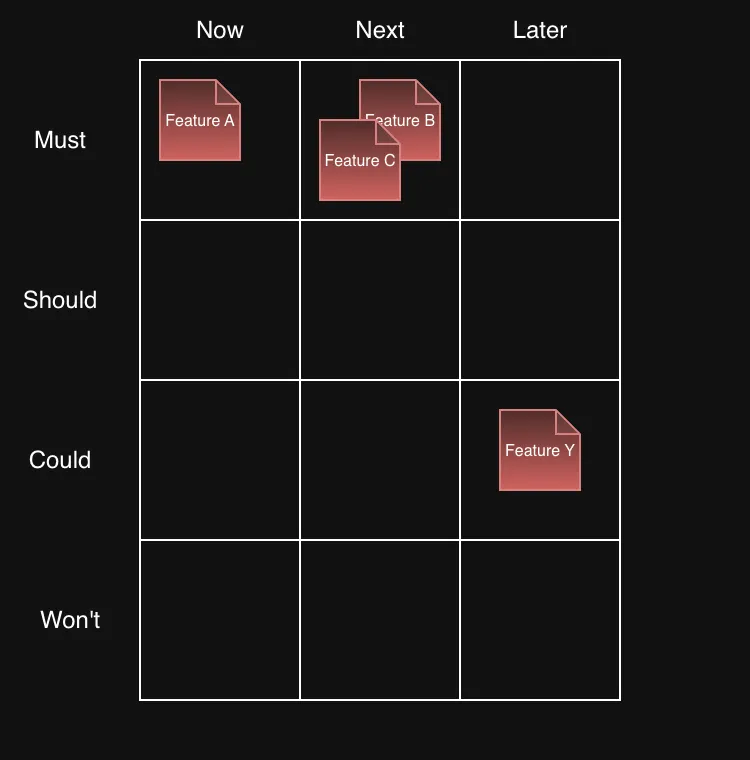
At Carble we used an intersection of
Now / Next / LaterandMust / Should / Could / Won'tas a prioritisation matrix for features and to stay aligned.
Splitting features into stages (Proto -> MVP -> Iteration 1) helps us learn and reprioritise continuously.
There is still a lot to learn and try and practice. I’m always on the lookout for better ways to work. I will keep updating it as I continue on my journey.